
Congress chose the standards. The USPTO chose to circumvent them.
Earlier this week, Angela Morris gave us some additional “impactful” quotes from Coke Stewart’s IAM interview. After reflecting on whether I’m just beating a dead horse here, I’ve concluded that I can’t let them stand.
The main reason is that while Coke continues to pay lip service to “data” and reaching “common ground,” she also continues to mischaracterize both her own record and the current state of play. Until we agree on just where we are and how we got there, it’s just not productive to be talking about “common ground.”
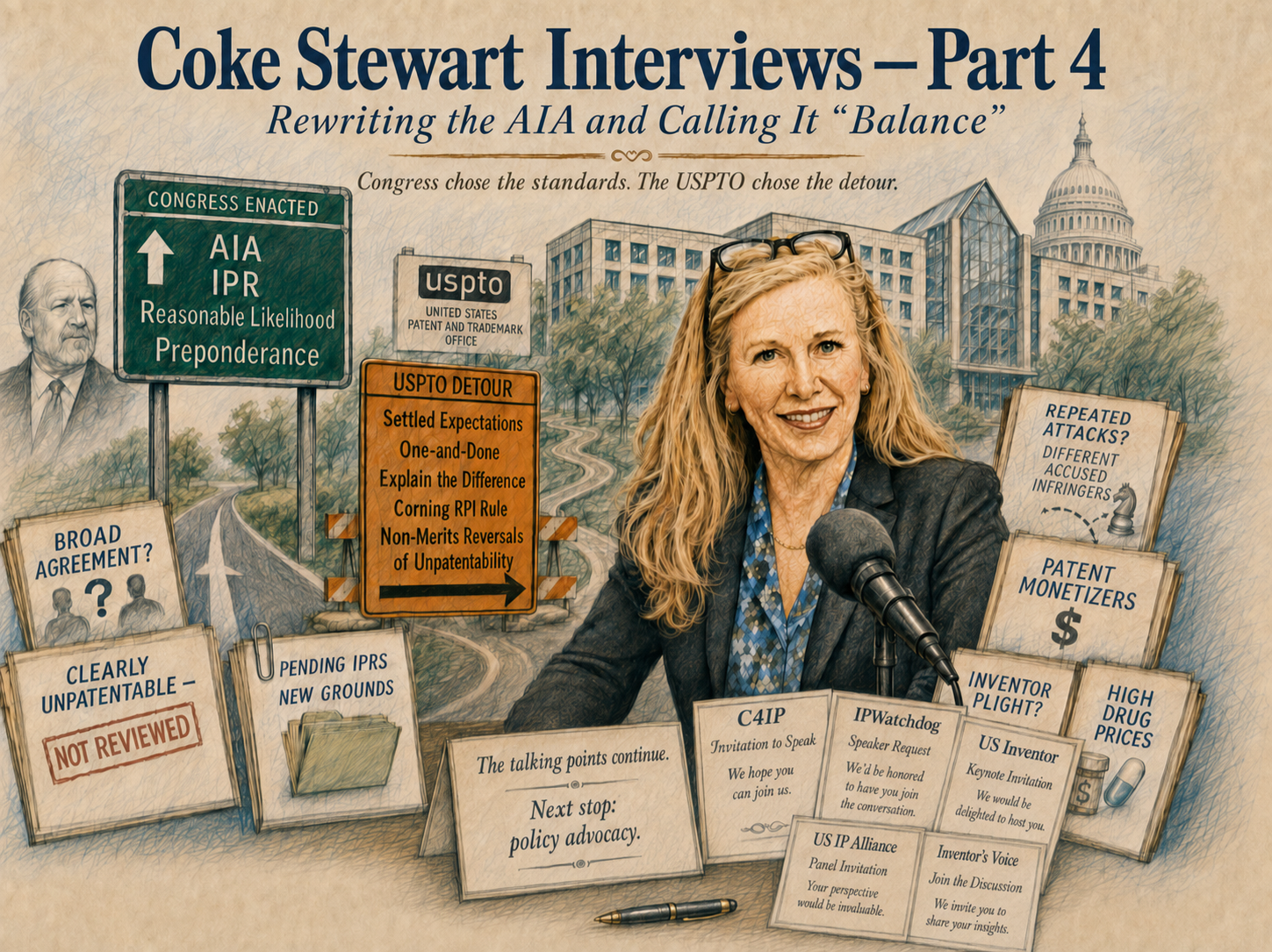
Coke says:
“We were trying to restore balance. Petitioners may not have viewed it that way, but one issue I think many people overlook is that there is broad agreement that clearly invalid or clearly unpatentable claims should be subject to review, whether because of an office error or a major change in the law.”
There’s some serious doublespeak here. Yes, we all agree that clearly invalid or clearly unpatentable claims should be subject to review. But that’s NOT the USPTO’s approach, as Coke’s qualification makes clear. You can’t count on the USPTO to invalidate a clearly invalid or clearly unpatentable claim that’s more than six years old UNLESS there has been a “major change in the law” or you can satisfy the USPTO’s extremely narrow definition of “examiner error” — which excludes the most obvious “error” of not finding the best prior art in the first place.
And under the USPTO’s new “explain the difference” regime, the Director can literally breathe new life into claims that a PTAB panel has found unpatentable if, for example, the panel did not explain to his satisfaction why its determination differed from an earlier, non-final, non-binding determination of the ITC. See, e.g.,Biofrontera Inc. v. Sun Pharmaceutical Industries, Inc., IPR2024-01312, Paper No. 58 (July 29, 2026); see also Facebook v. Express Mobile, IPR2021-01226, Paper No. 68 (June 25, 2026) (similar, for district court); Sinclair Pharma v. Hyrdrafacial, LLC, IPR2025-00145, Paper No. 41 (Feb. 12, 2026) (deinstituting an instituted proceeding based on the “explain the difference” memo).
That’s a bizarre way to run a patent office. Why is the USPTO suddenly giving that kind of deference to non-binding ITC decisions, and vacating, on non-merits grounds, its OWN decisions finding claims unpatentable? Is there “broad agreement” on that approach?!
The better rule — and, ironically, the one that came much closer to implementing the principle Coke now says enjoys “broad agreement” — was in Director Vidal’s June 2022 memo, which provided that if the petitioner made a compelling case for unpatentability, then there would be no discretionary denial. But Coke got rid of that rule in one of her first substantive acts as Acting Director.
Speaking of the system before she got her hands on it, Coke says:
“Under the current system, anyone can challenge an issued patent, at almost any time — and repeatedly.”
That’s misleading at best — under General Plastic and the PTAB’s Consolidated Trial Practice Guide, any single petitioner generally gets only one shot at an IPR, and under the pre-existing Fintiv-Sotera rules, the petitioner often had to promise not to raise in district court arguments that it could have raised in the IPR. But that wasn’t good enough — under the Coke-Squires rules — as proposed and also as currently applied — if ANOTHER accused infringer has managed to lose before the USPTO, district court, or the ITC in a non-final decision, the USPTO slams the door on IPRs by any subsequent accused infringer.
That bears no resemblance to anything suggested by Congress in the AIA, which made it pretty clear that ANYONE could bring an IPR as long as they brought it within 12 months of being sued. And how is that unfair? The only patentees who “suffer” repeat challenges under the AIA are those that are suing multiple defendants — often an entire industry — based on a patent or family of patents with broadly written claims.
Do we really need to feel sorry for those patentees, especially considering that many of them bought their patents second hand? Isn’t the more important question to resolve whether one single entity — often a non-practicing entity — is truly entitled to a cut of the profits of an entire industry?
It’s not “harassment” if you’re sued for tens or hundreds of millions of dollars, and seek your own congressionally-authorized challenge to the patent before the agency that issued it.
One can’t help observing that the USPTO’s rules particularly benefit well-funded patent assertion entities, and NOT the struggling individual inventor whose “plight” supposedly motivated these changes. If Coke and Squires don’t understand this, it’s only because they failed to do any study whatsoever before implementing the changes, and continue to blind themselves to the impact of their changes.
Coke continues:
“The issue is not preserving patents that should not exist. The issue is preventing repeated attacks on established rights.”
Yet another non-sequitur. As already explained, the “settled expectations,” “explain the difference,” and “one-and-done” rules plainly preserve patents that should not exist. Same for the new Corning-based RPI rule, and also the Director’s use of his Director Review authority in cases like Blackhawk v. Interactive. THAT IS THE ISSUE. And as also explained, “repeated attacks” by DIFFERENT accused infringers is a feature, not a bug, of the system Congress created. Note also that she’s slipped in “established” to modify “rights,” and yet the actual practice is that a non-final, non-binding decision by the ITC or a district court against one infringer can convert a patent into an “established right” against someone else.
“Settled expectations” in particular has nothing to do with “repeated attacks” and is particularly difficult to defend in the pharmaceutical context. Generic and biosimilar manufacturers often need to address barriers caused by patent thickets well before they have Article III standing to challenge those patents in district court. There is no good reason for expectations surrounding later thicket patents to become “settled” during a period when those patents will not be infringed because the original patent still blocks generic or biosimilar entry. Knocking out those challenges based on “settled expectations” makes zero sense, unless you like high drug prices. See Post on Amgen v. BMS (LinkedIn, Aug. 2025); Post on Amgen v. BMS Rehearing Request (LinkedIn, Sept. 2025)).
For any maximalist — including Coke — who reads this, I strongly suggest that any time you talk about “repeated attacks” on a patent, you distinguish between attacks brought by a single entity (or its RPIs), and those brought by different, unrelated entities. The former is NOT the controversy here; the latter is. Conflating them obscures the issue.
Finally, we have this:
“The institution standard is relatively low, the burden on petitioners is relatively low and appellate review is highly deferential. I do not believe Congress intended to create a system that second-guesses patentability decisions under such a low threshold, but that is effectively what happened.”
So she doesn’t “believe” that Congress intended to impose the very standards — reasonable-likelihood for institution; preponderance-of-the-evidence for unpatentability — that it plainly and specifically wrote into the statute? How does that make sense?
And why should it be up to the USPTO Acting Director to unilaterally and retroactively circumvent those standards? Why not do what John Squires told the Senate and the public that he would do — study the issue, and then consult with Congress before making any significant changes?
One answer could be that these changes were demanded by Howard Lutnick, and Coke had no choice but to implement them quickly. That may well be what happened. But it just underscores that the changes were made with no attempt to actually study the issues.
And as shown above — and in the previous posts in this series — Coke’s post-hoc justifications for the changes don’t make a lot of sense.
Leave a Reply