
A Howard Lutnick trading card, 13 million “inventions” the world would never otherwise have seen, and the patent-maximalist assumptions driving current policy.
Perhaps nothing symbolizes the intellectual and philosophical decline of the USPTO so much as its decision to create an inventor trading card featuring Howard Lutnick.
Director Squires unveiled the card at the “America 250 signing ceremony and Commerce Secretary Howard W. Lutnick’s Trading Card unveiling,” back on July 23.
(Sorry, I’m just catching up, but his remarks are truly timeless for anyone interested in how shallow the intellectual underpinnings of this administration’s patent policies are.)
The USPTO apparently issued only the front of the card. I looked for a reverse side online and couldn’t find one, so I supplied my own — based, to the best of my ability, on the available record.
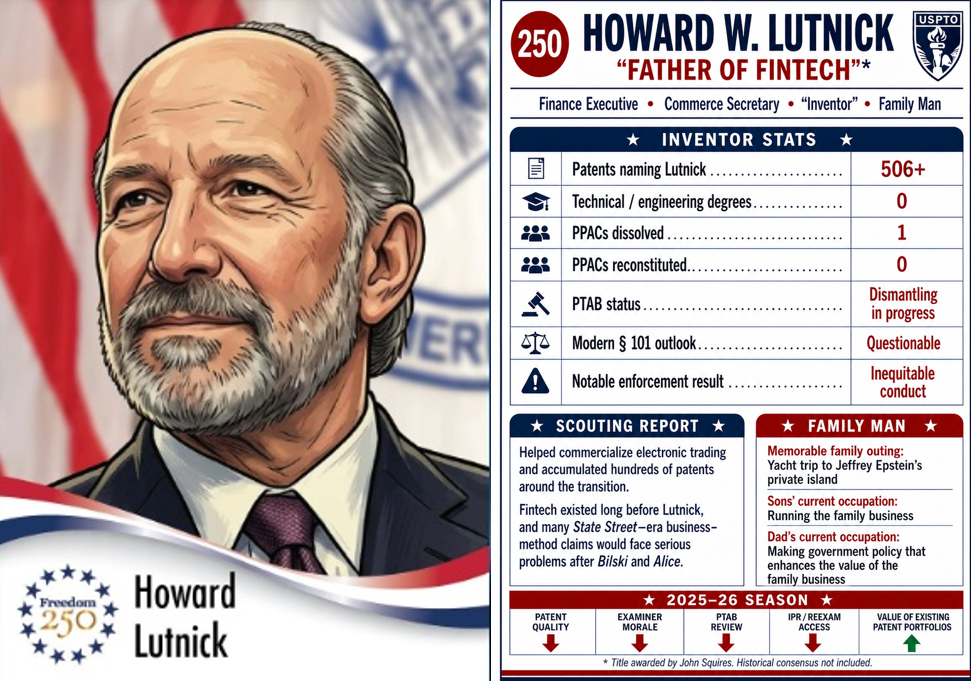
The card is silly. The ideas behind it are both silly and scary.
I’ll let Director Squires mostly speak for himself. Again and again, the same basic errors appear: association becomes causation, and the issuance of a patent becomes proof of social value. An invention was patented, therefore the patent caused the invention. An industry obtains lots of IP rights, therefore IP created its GDP and jobs. Howard Lutnick obtained hundreds of patents relating to electronic trading, therefore he created fintech.
I’ll focus on his key claims, and explain, in some cases with reference to my past work on these issues, just how lacking in substance they are.
Since this post goes on at some length, here’s a roadmap to his claims, which are largely self-refuting for anyone who has worked in the patent field:
Patent rights are enshrined in the Constitution.
America’s economic success is due to the patent system, which creates a “butterfly effect.”
The patent bargain — “disclosure for exclusivity” — is the “ultimate Art of the Deal.”
The patent bargain works because “Capital markets look for clear signals about where investment is most likely to flourish.”
The 13 million patents that the USPTO will have issued by spring 2027 represent “13 million new inventions, improvements, and advances in our quality of life since America was born—that the world would NEVER have otherwise seen.”
“Every piece of IP we put into circulation is a potential job, a new business, a competitive advantage, an investible asset. And is yet another win for both society and the Constitutional foresight of our Founders.”
“In the U.S., IP intensive industries account for roughly 41 percent of U.S. economic output—estimated to be around $6.2 trillion dollars—and support more than 63 million American jobs, as well as industries that power America’s global trade competitiveness.”
“In fact, IP-intensive services account for about 31 percent of total U.S. Service EXPORTS, making them one of the largest contributors to the United States’ global services SURPLUS.”
“We are strengthening the business of America because we are strengthening the very patent bargain itself.”
Secretary Lutnick “improved financial services forever,” and “is the father of the industry today we all call Fintech.”
In Lutnick, “[T]here could be no better suited, no more courageous, no more creative, and no more passionate friend, supporter, advocate, or visionary to the importance of intellectual property, and what it means to all Americans.”
“And, of course, it almost goes without saying that President Donald J. Trump is the most brilliant creator and generator of brand value the world has ever seen!”
Some of those propositions confuse correlation with causation; a few are simply silly. But none of them tells us anything at all about whether patents should be stronger or easier to enforce.
Claim 1: Patent rights are enshrined in the Constitution.
In all-too-familiar maximalist-speak, Squires grossly misrepresents the Constitution:
“You see, two years earlier, our Founders ratified perhaps the most remarkable idea recorded in language of all time. The U.S. Constitution.
And even more remarkably, they placed intellectual property rights protection directly into the beating heart of a young America.
In Article 1, Section 8, Clause 8, they enshrined a right for you, and me, and every American, which secures for a limited time ‘to Authors and Inventors the EXCLUSIVE RIGHT to their respective writings and discoveries.’
And there it is.
The word ‘right.’
It’s the only recitation of a ‘right’ in the textual document itself. Otherwise, you have to look to the first 10 amendments—our Bill of Rights. But here it is unto itself—boldly, remarkably, daringly, beautifully—and ultimately singularly appearing in Article 1 among the Seven articles of the ‘Constitution Proper.’”
Yes, it appears “boldly, remarkably, daringly, and beautifully” — along with the power to “fix the Standard of Weights and Measures” — since otherwise Congress would be powerless to grant patents or copyrights, even though both had been fixtures of English law since 1624 (patent) and 1710 (copyright), states were already granting patent-like exclusive rights to inventors, and 12 of the 13 states had enacted copyright laws before the federal Constitution took effect.
Sarcasm aside, there’s nothing bold, remarkable, or daring about giving Congress the power to grant these kinds of rights.
As with many other maximalist tropes, I “pre-futed” this one in my letter to the Senate Judiciary Committee opposing Squires’s nomination:
1. Patent rights are not “enshrined” in the Constitution.
The Congress shall have Power . . . To promote the Progress of Science and useful Arts, by securing for limited Times to Authors and Inventors the exclusive Right to their respective Writings and Discoveries.
– U.S. Constitution, Article I, Section 8, Clause 8.
Some rights actually are “enshrined” in the Constitution – Due Process, Free Speech, and Equal Protection, to name a few. The Constitution guarantees those rights unconditionally, to protect citizens from government overreach. By contrast, the Constitution does not provide any rights to inventors. It just says that Congress can create a patent system – a system of statutory rights, upon which Congress can place whatever conditions it wants. It doesn’t say Congress has to, and says nothing about the form that system should take.
And yet, patent maximalists inside and outside the USPTO routinely invoke the Constitution as a justification for making patents even stronger. See, e.g., PREVAIL Sec. 2 (1) (referring to “patent property rights enshrined in the Constitution of the United States”); RESTORE Sec. 2(4) (referring to “the constitutionally protected patent right”); see also Tr. 47:10-16 (“my world . . . is generally governed by . . . Article 1, Section 8, Clause 8”).
The Constitution in no way supports even stronger patent rights. If the Framers had any idea that, after more than 200 years of technological advances and multiple technological “revolutions,” we’re still handing out 20-year patent terms for nontechnological inventions and minor improvements, and considering making patent rights even stronger, they’d be astonished – if not appalled.
Squires’s observation that this is the only recitation of “Right” in the main text of the Constitution tells us nothing. “Exclusive right” was a descriptive term used for patents and copyrights, and the clause is defining a power of Congress. Nor is the word “right” talismanic. The main text protects the writ of habeas corpus while calling it a “Privilege,” and the Bill of Rights protects important rights without invariably using the word “right.”
Although this might seem harmless, it’s not. Maximalists like Director Squires use this kind of warped rhetoric to inflame the passions of credulous small inventors — and repeat the same tropes in congressional testimony, where they help dress up donor-friendly patent policy as constitutional principle.
Claims 2-4: The “butterfly effect,” the “ultimate Art of the Deal,” and capital-market signals
I’m grouping these claims together and won’t say much about them. They are typical maximalist talking points that (1) are not empirically supported and (2) at best support the existence of some patent system, not the patent system as currently configured, much less the maximalist view that the current system needs to be expanded and strengthened.
Even if patents sometimes encourage disclosure, investment, or invention, that tells us almost nothing about the optimal patent term, eligibility rules, obviousness standard, remedies, or mechanisms for challenging patents after they issue.
As discussed in my letter opposing Squires’s nomination, the system is already badly miscalibrated in several respects, and advances in AI make those problems increasingly urgent. See Letter Opposing Squires’s Nomination, Truth Nos. 5 (“Patents last too long”), 6 (“Patents are too easy to get”), and 16 (“One truth to rule them all: Advances in AI will result in explosive technological growth without the aid of the patent system”). Yet Squires is using these empirically unsupported assumptions to push the system in exactly the wrong direction, while showing remarkably little interest in seriously studying whether stronger and harder-to-challenge patents actually promote innovation.
Claim 5: The 13 million patents that the USPTO will have issued by spring 2027 represent “13 million new inventions, improvements, and advances in our quality of life since America was born—that the world would NEVER have otherwise seen.”
The maximalist claim that inventions would not be made but for patents was also heard at the recent hearing on subject matter eligibility. Iancu, Tr. 139:35-44 (“The cost of a drug that is not developed and brought to market after a lot of research and development is basically infinite.”); Tillis, Tr. 1:42:08-16 (“The cost of a drug and a therapy that could save millions that was never invented is zero [sic; infinite?]”).
I addressed this form of “innovation illiteracy” in Truth No. 4:
4. The vast majority of patented inventions are independently invented by others at about the same time.
Independent invention is the norm, not the exception. That goes for nearly all of the iconic inventions of the past, including the telegraph, the light bulb, the telephone, and radio, and it certainly goes for the vast majority of incremental improvements that are patented today. Excellent books on how innovation happens – all of which thoroughly document the fact of independent invention – are:
Kevin Kelly, What Technology Wants (2010)
Steven Johnson, Where Good Ideas Come From (2010)
Matt Ridley, How Innovation Works: And Why It Flourishes in Freedom (2021)
And an excellent law review article is:
Mark A. Lemley, The Myth of the Sole Inventor, 110 Mich. L. Rev. 709 (2012)
There are exceptions to the basic rule of independent invention – for example, new chemical entities will typically not be independently invented, and the myth of the sole inventor actually does play out from time to time – often with relatively simple “gadget” patents for the sorts of inventions we see on Shark Tank.
But independent invention is the norm across most fields, and this has rightly caused all of these authors to question whether the patent system, as currently configured, really is the best way to promote innovation. See Ridley at 342-350; Johnson at 213-246; Kelly at 131-155; Lemley at 760.
Of course, a maximalist will say that all of those independent inventors were motivated by the prospect of getting a patent. But that’s not necessarily the case. When someone asked Sir Humphry Davy why he didn’t patent an electric lamp he had invented to improve mine safety, he responded:
I never thought of such a thing: my sole object was to serve the cause of humanity; and if I have succeeded, I am amply rewarded in the gratifying reflection of having done so. More wealth could not increase either my fame or my happiness. It might undoubtedly enable me to put four horses to my carriage, but what would it avail me to have it said that Sir Humphry drives his carriage and four?
Davy was one of about 37 giants on whose shoulders Thomas Edison stood when he did a bit of routine experimentation to find a decent filament for the already-invented light bulb, got credit for “inventing” the whole thing, and patented the hell out of it.
More broadly, there is an enormous natural experiment testing Squires’s premise that America’s patent system is what makes invention happen: it’s called recorded human history. Here’s a picture of the first three volumes of A History of Technology (Oxford University Press 1950), each running about 800 pages, and covering technological advances through 1750. Humanity somehow managed to fill all that space with invention before there was a United States, much less the patent system Squires credits with producing innovations “the world would NEVER have otherwise seen.”

Finally, as with the previous claims, even if there were a grain of truth behind Squires’s statement, it says nothing about whether the system is currently calibrated for optimum invention and innovation. As explained at length in my letter opposing his nomination, it isn’t.
Claim 6: “Every piece of IP we put into circulation is a potential job, a new business, a competitive advantage, an investible asset. And is yet another win for both society and the Constitutional foresight of our Founders.”
He keeps saying this, so I’ll just quote myself from the first time I heard him say it — in his first speech as Director:
Here’s one place where his thinking needs work:
“Our Office is not just an administrative agency; we are a strategic arm of national economic policy; we are the Department of Commerce’s Central Bank of Innovation. Every piece of IP we put into circulation is a potential job, a new business, a competitive advantage, or an investible asset. And yet another win for both society and the Constitutional foresight of our Founders.”
Of course every patent has potential upsides. But patents also have serious potential downsides: lost jobs, suppressed competition, monopoly pricing, foreign ownership of the majority of U.S. patents, and heavy taxes on businesses that independently invented better products. And all of this comes on top of the separate problem of low-quality patents, which Director Squires himself has acknowledged. Patent policy, like any economic policy, must weigh the costs against the benefits.
That is why, in my letter opposing his nomination (https://lnkd.in/eBuhpuDf), I emphasized several core truths about how the patent system actually works:
• Patents distort free markets.
• Patents last too long.
• Patents are too easy to get.
• Foreign inventors get more U.S. patents than U.S. inventors.
• Most inventions are invented independently around the same time.
• Strengthening existing patents benefits patent monetizers – including foreign investors – and is a deadweight tax on society.
• Drug patents often extend monopolies based on minor advances, keeping U.S. drug prices high.• AI will drive explosive technological growth, with or without patents.
• The USPTO must safeguard the public’s side of the patent bargain.
I hope that as Director Squires begins to form patent policy, he revisits these truths and recognizes that the loudest voices in this debate do not always serve the best interests of the U.S. or its economy. What’s needed now is a USPTO Director who makes the public interest the touchstone of policy – and who listens carefully not just to entrenched voices on both sides, but also to impartial experts, including academics in economics and in law.
That’s really the point. A patent is not automatically a “win for society.” It is a government-granted, market-distorting, right to exclude, and whether issuing or strengthening a particular class of patents improves social welfare is an empirical question — not something established by calling patents “investible assets.”
Claim 7: “In the U.S., IP intensive industries account for roughly 41 percent of U.S. economic output—estimated to be around $6.2 trillion dollars—and support more than 63 million American jobs, as well as industries that power America’s global trade competitiveness.”
This claim is primarily drawn from the USPTO’s deeply misleading Intellectual Property and the U.S. Economy: Third edition (released in 2022), which the agency issued over my strenuous internal objection, and which I dealt with as Quarter-Truth No. 14 in my letter opposing the Squires nomination.
Even Squires’s quotation is a bit of a statistical Frankenstein. The 41 percent and 63-million-job figures correspond to the Third Edition, but that report estimated roughly $7.8 trillion in GDP, not $6.2 trillion. The $6.2 trillion appears to come out of nowhere — it’s not even from an earlier edition of the report.
About a week after these remarks, the USPTO published yet another version of the study. I’ve now written three separate posts about it, including one reporting that Director Squires authorized 30 minutes of “other time” for USPTO employees to read it, and offered a chance at a $100 gift card for commenting on it on an internal blog.
Again, in addition to the report’s acknowledged causation/correlation problem, the large numbers are exactly what you would expect from an economy with a very large GDP. If you arbitrarily divide the economy into industries with above-average and below-average IP intensity, you’ll have divided it into two very large, multi-trillion-dollar parts. That’s where the trillion-dollar numbers — including, nonsensically, for design patents — come from.
My critiques of the latest edition of the report are here, here, and here.
Claim 8: “In fact, IP-intensive services account for about 31 percent of total U.S. Service EXPORTS, making them one of the largest contributors to the United States’ global services SURPLUS.”
This is a very random statistic. Here, Squires has veered into a narrow corner of “intellectual property” — that which can be swept into a category called U.S. service exports.
The statistic comes from the U.S. Chamber of Commerce’s 2026 International IP Index, which defines “IP-intensive services” to include IP licensing, R&D, software, and audiovisual services. It thus aggregates software, R&D, entertainment, and various forms of IP licensing, calls the result “IP-intensive,” and finds that it represents 31 percent of services exports.
That tells us essentially nothing about the contribution of patents, much less whether there is a trade surplus attributable to “patent-intensive services.” And even as a broader claim about IP and trade, it is highly selective: the USPTO’s own latest report shows that IP-intensive industries account for a larger share of U.S. commodity imports than exports, and that 64 of 76 IP-intensive commodity-exporting industries run trade deficits.
More fundamentally, in a speech about the importance of patents and invention, Squires has injected a statistic driven by a broad assortment of activities and IP regimes.
It’s a common patent-maximalist tactic that I addressed in Quarter-Truth 17:
17. What is true for other forms of IP is not necessarily true for patents.
Those arguing for stronger patents often use the term “IP” rather than “patent.” This enables them to make assertions that apply primarily to regimes other than patent law when arguing for stronger patent protection.
The most obvious point is that in trademark, copyright, and trade secret law, there is little question about who owns the right, and why that person or corporation’s right should be respected. In patent law, however, “ownership” of the rights is much less clear, since (1) questions often arise about whether an accused product actually infringes the properly construed claims, and (2) validity is frequently contested. In addition, patent rights do not reflect “moral rights” in the same way copyrights, trademarks, and trade secrets do. For those regimes, infringement generally involves knowledge of the right and intentional copying of it. In patent law, by contrast, independent invention is the norm (see Truth No. 3), and the patent right merely reflects the government’s initial determination that the patentee was the first to apply for a patent on the invention. In patent law, independently-inventing infringers often have the greater “moral” claim to the inventions they are accused of “stealing,” since they are the ones who invested in implementing and commercializing it.
As a concrete example, a recent patent maximalist report states that “businesses rely on strong IP rights to capture a return on their investments, securely engage in international partnerships, and protect themselves from counterfeiting, piracy, and theft.” Kirti Gupta, Andrei Iancu, Walter G. Copan, and Chris Borges, Protecting Intellectual Property for National Security, A Transition Report for the New Administration (Center for Strategic and International Studies 2025), at 32. But counterfeiting is primarily trademark infringement, piracy is primarily copyright infringement, and “theft” is a misnomer for any kind of IP other than trade secrets (see Quarter-Truth No. 3). And yet, except for some vaguely worded recommendations using the term “IP,” all of CSIS’s recommendations have to do with strengthening patent law. Id. at VIII-X.
Likewise, although Senator Tillis kicked off the IP Subcommittee’s recent hearing on Foreign Threats to American Innovation and Economic Leadership (May 14, 2025) with statements about the importance of strengthening U.S. patents, the focus of the witness testimony was on other IP regimes, and there was no significant testimony from any of the witnesses on why or how strengthening U.S. patents would address any “foreign threats to American innovation.” As discussed in Truth No. 8, strengthening U.S. patents will just make it easier for foreign entities to sue U.S. businesses in the U.S., but nobody made that point at the hearing.
Significantly, anyone arguing for a change to copyright, trademark, or trade secret law will usually focus on those doctrines and use their proper, specific names. Serious discussions of patent law should likewise focus on patent law, and avoid use of the misleading “intellectual property” umbrella term.

Claim 9: “We are strengthening the business of America because we are strengthening the very patent bargain itself.”
Director Squires doesn’t say just how “we” are strengthening the patent bargain, but presumably he’s referring at least in part to making it harder to challenge patents at the PTAB, thereby ensuring that even weak patents retain considerable nuisance value.
This again reflects a basic misunderstanding of how markets work. Patent rights deliberately distort the free market by allowing their owners to exclude competitors. That may sometimes produce offsetting benefits, but simply making those rights stronger does not necessarily “strengthen the business of America.”
Yes, it may strengthen the patent portfolios of entities like Howard Lutnick’s family firm Cantor Fitzgerald, or Squires’s former client Fortress. But that doesn’t translate into strengthening American business as a whole. Businesses on the other side of those patents face higher costs, greater litigation risk, and greater barriers to implementing technology they may have developed independently.
If anything, the relevant question is whether strengthening patent rights produces enough additional innovation to justify those costs. Squires simply assumes the answer. And, as already discussed, he’s gotten it wrong.
Claim 10: Secretary Lutnick “improved financial services forever,” and “is the father of the industry today we all call Fintech.”
This is just silly.
Lutnick and Cantor Fitzgerald were important participants in the transition from voice brokerage to electronic trading, particularly in fixed-income markets. But electronic finance and automated trading long predated Lutnick, and numerous firms were moving toward greater automation as computing and network technology improved.
Lutnick’s companies managed to obtain a very large portfolio of patents covering aspects of electronic financial trading. Many of those claims, particularly claims directed primarily to rules for conducting financial transactions using computers, would at minimum face serious questions under today’s § 101 jurisprudence after Bilski and Alice.
None of this establishes that electronic trading depended on Lutnick’s patents or that, without those patents, fintech would somehow not have developed.
And that is the same mistake as Claim 5 — treating patents as proof of causation. Lutnick and Cantor Fitzgerald may have succeeded in the marketplace while building a substantial patent portfolio around electronic trading. But that does not show that the patents caused the transition, much less that fintech would not have developed without them — or without Lutnick.
Claim 11: In Lutnick, “[T]here could be no better suited, no more courageous, no more creative, and no more passionate friend, supporter, advocate, or visionary to the importance of intellectual property, and what it means to all Americans.”
I’ve looked, but I’ve been unable to find any meaningful public statement by Howard Lutnick explaining his philosophy of intellectual property and “what it means to all Americans.”
What we do know is that he dissolved the Patent Public Advisory Committee back in March 2025 and that it still has not been reconstituted, suggesting little interest in the statutory mechanism Congress created to obtain public input on USPTO policy choices.
Likewise, Lutnick had Acting Director Stewart move forward with major changes to PTAB practice even after Squires had given the Senate quite specific assurances about what he would do once confirmed. Squires said he had “no pre-disposition to alter the PTAB’s authority or restrict IPR access,” promised to study the issues before making major changes, and said he would work with stakeholders, agency leadership, and Congress to determine what reforms, if any, were appropriate. He even specifically recognized the importance of IPR access in addressing abusive patent practices and questionable pharmaceutical patents. See Squires Confirmation — Good News! (Substack, September 18, 2025). In other words, Lutnick had effectively rendered those commitments meaningless before Squires even took office.
Most of what we know about Lutnick’s patent-policy philosophy comes indirectly from Coke Stewart and John Squires, both of whom have portrayed him as a driving force behind the USPTO’s current agenda — including cutting back IPRs and reexaminations, imposing new procedural restrictions on patent challenges, expanding patent eligibility, and emphasizing examiner production over patent quality.
The common thread is straightforward: make patents easier to obtain, harder to challenge, and more valuable once issued. That is a coherent agenda for existing patent owners and patent monetizers. It is not a coherent account of what intellectual property “means to all Americans.”
Claim 12. “And, of course, it almost goes without saying that President Donald J. Trump is the most brilliant creator and generator of brand value the world has ever seen!”
This seems like more than just sycophancy, since Trump wasn’t even there to hear it. Perhaps Squires truly believes it, which could explain a lot.
I’m pretty sure the students of Trump University, the creditors of Trump Shuttle and his bankrupt casinos, the handful of people who bought Trump Steaks or Trump Vodka, and the customer whose $640 Trump watch arrived emblazoned “RUMP” have a somewhat less exalted view of the Trump brand.
And that’s before asking what he has done lately to the value of the American brand.
The larger problem is not any one of these claims. It is a way of thinking about patent policy in which patents are presumed to cause innovation, large numbers are presumed to prove success, and stronger rights are presumed to benefit the country. Once those premises are taken as articles of faith, there is little reason to ask the question that should come first at the USPTO: what patent system actually produces the greatest benefit for the American public?
Leave a Reply